The Myth of Eastern Liturgy
With all this negativity at the very origins of the liturgical movement, what could have induced the Council fathers of Vatican II to turn eastward for positive paradigms to imitate? The answer, I think, is what I would call “the myth of eastern liturgy.”
The philosopher Karl Popper said the world as we know it is our interpretation of observable facts in the light of theories of our own invention. In other words, we invent our world even while we think we are just observing it and reporting on it.
Of nothing is this truer than of the western use of eastern liturgy. I have often been tempted to write a book entitled Inventing Eastern Orthodoxy, in which one chapter would have to be “Inventing Eastern Liturgy.” For the western study and exploitation of eastern liturgy has gone through several phases, each taking as its point of departure not anything in eastern liturgy, but the felt needs of the viewer.
The process began in the sixteenth century. The first serious studies and translations of eastern liturgies were apologetic in intent, done mostly by German Catholics actively engaged in the Reformation upheaval, like Georg Witzel (d. 1573), Johannes Cochlaeus (Dobeneck) (d. 1552), and the Dominican Ambrose Pelargus (Storch) (d. 1561). (6) Their aim was to defend Catholic theological positions with ammunition from the east. (7)
In the seventeenth and eighteenth centuries the baton passed to France and Italy, In the period of what David Knowles called “the great historical enterprises”–the projects of the Maurists like Jean Mabillon and of the Jesuit Bollandistes in Brussels (8)–and, for eastern liturgy, the Dominican Jacques Goar (d. 1653), Jean Morin (d. 1659), Isaac Habert (d. 1668), bishop of Vabres, Eusebe Renaudot (d. 1720) in France; and in Rome, Leo Allatios (d. 1669), a Greek from Chios, and two related Maronites, Joseph Simon (d. 1768) and Joseph Louis Assemani (d. 1782).
But by the middle of the eighteenth century things had begun to sour, when the presumed superiority of Latin liturgical usages, famously formulated in the Praestantia ritus latini of Benedict XIV’s brief Etsi pastoralis (May 26, 1742), was actively fostered by the papacy of the day. (9) We have already seen how this was later exploited by Prosper Gueranger in his fight for the Romanization of the liturgy in France: disparaging eastern liturgy became a means of enhancing Roman usage.(10)
Less than two generations later, in the debacle of World War I, the Benedictine-fueled Catholic liturgical movement will turn Gueranger’s equally Benedictine revival romanticism on its head, and Catholic enthusiasts like the Benedictines of Amay/Chevetogne, among them Olivier Rousseau, one of the early historians of the liturgical movement, will produce an equally romantic lyrical vision of eastern liturgy that has lasted more or less until our own day. (11)
My point in reviewing all this is not to sketch a history of the (largely western) study of eastern liturgy (though there is need for one), but simply to evoke the complications and pitfalls that stand in the way of any serious attempt to analyze closely any slice of the human cultural reality. This should not deter us; it should, however, induce us to proceed with care, and without the customary superficiality with which profound matters are usually treated by those innocent of cultural history and the hermeneutical necessities it imposes.
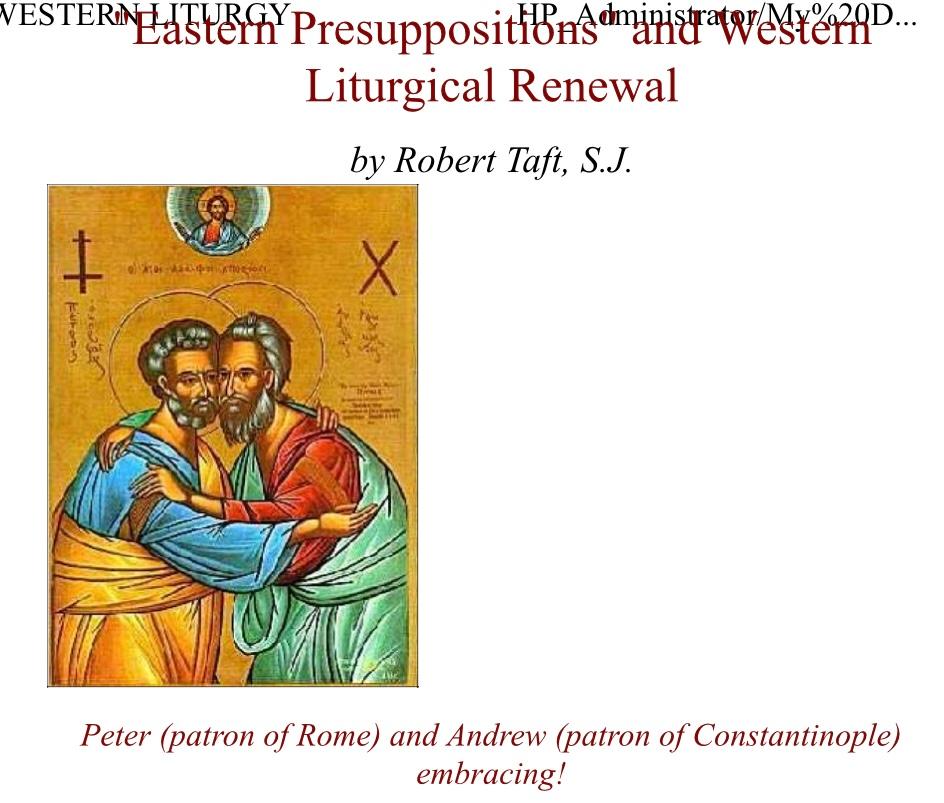
ROBERT TAFT SJ ON EASTERN AND WESTERN LITURGY file:///C:/Documents%20and%20Settings/HP_Administrator/My%20D… 4 of 17 9/4/2007 4:09 PM